Predictive Maintenance using AI
Overview
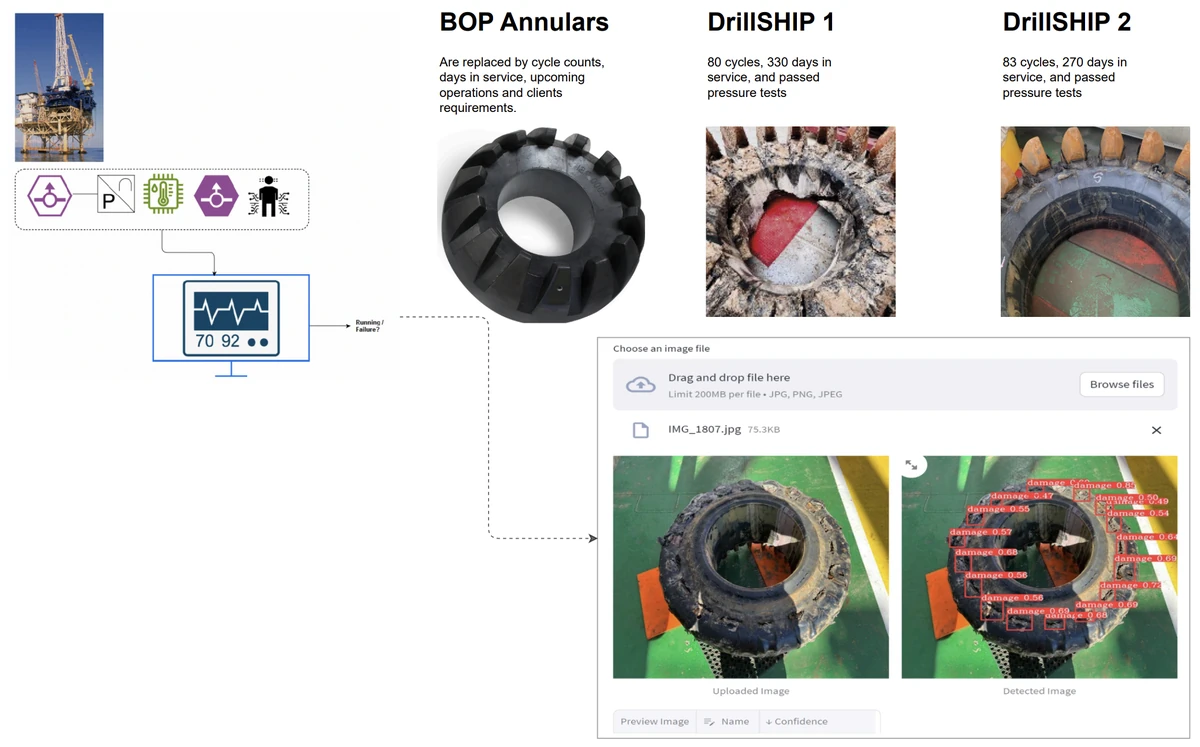
We have a strong track record in predictive maintenance, remaining useful life estimation, and asset health management for critical industrial systems. A representative example of our work is an AI-driven predictive maintenance solution developed for drilling equipment such as BOP annulars. The system combines machine learning, operational data, and automated visual inspection to assess asset condition and forecast failure risk. By analyzing usage cycles, days in service, pressure test results, real-time condition monitoring, and computer vision–based damage detection from inspection images, the solution enables condition-based maintenance decisions that reduce unplanned downtime, improve safety, and extend asset service life across drilling operations.
Research Areas
We employ time-series analysis, anomaly detection algorithms, and deep learning architectures to process complex sensor data streams. Our research integrates IoT sensor networks with advanced analytics to create comprehensive predictive maintenance frameworks for industrial equipment.
Applications
- Drilling equipment health monitoring
- Manufacturing equipment monitoring
- Rotating machinery diagnostics
- Industrial robotics maintenance
- Fleet management systems
Impact
Our predictive maintenance solutions help industrial partners reduce unplanned downtime, with early warning alerts that identify potential failures days or weeks in advance. This leads to improved operational efficiency, enhanced safety, and extended equipment lifespan across various sectors.
Team
- 2 PhD students
- 1 Research Associate
- Collaborative partners from manufacturing and energy sectors
Selected Publications
[1] T. H. Vu, T. Thanh Nguyen and E. Elyan, “An Evolutionary Neural Architecture Search-Based Approach for Time Series Forecasting,” 2025 IEEE Congress on Evolutionary Computation (CEC), Hangzhou, China, 2025, pp. 1-8, doi: 10.1109/CEC65147.2025.11043002
[2] T T Nguyen, H Vu, T Dang, E Elyan, T Son Vu, and T Thanh Nguyen (2025). A Feature Transformation Technique for Improving Ensemble Learning Systems. In: Nguyen, N.T., et al. Intelligent Information and Database Systems. ACIIDS 2025. Lecture Notes in Computer Science(), vol 15684. Springer, Singapore. doi: 10.1007/978-981-96-6005-6_21
[3] Vu, T.H., Elyan, E., Vorley, W., Goodlad, J., Dang, T., Nguyen, T.T. (2025). FAT: Fusion-Attention Transformer for Remaining Useful Life Prediction. In: Antonacopoulos, A., Chaudhuri, S., Chellappa, R., Liu, CL., Bhattacharya, S., Pal, U. (eds) Pattern Recognition. ICPR 2024. Lecture Notes in Computer Science, vol 15310. Springer, Cham. 10.1007/978-3-031-78192-6_19